


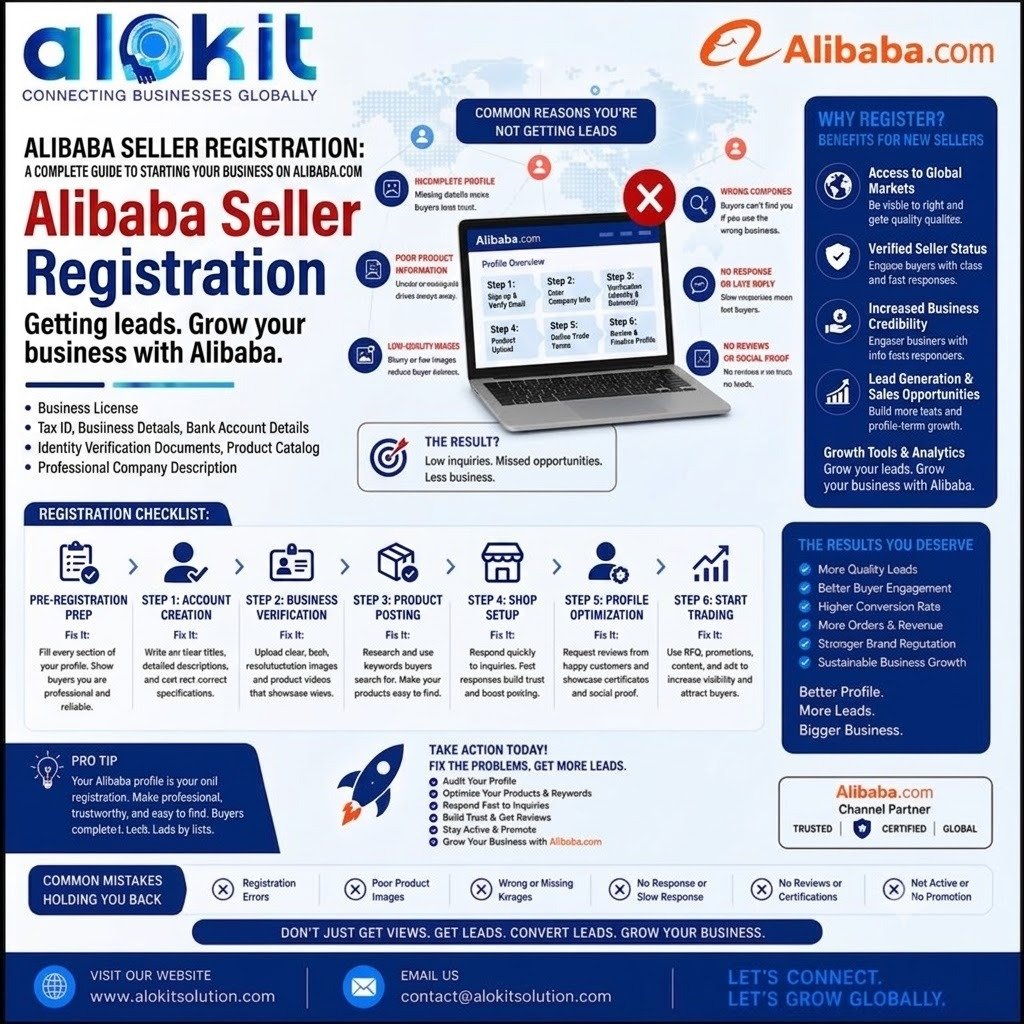
For U.S. manufacturers, wholesalers, exporters, and suppliers looking to grow their business, Alibaba.com can be an important B2B marketplace for connecting with buyers from around the world. However, getting started requires more than simply creating an account. Businesses need to understand the Alibaba Seller Registration process, prepare the right business documents, select an appropriate seller plan, and build a professional company presence that inspires confidence among U.S. and qualified B2B buyers.
If you are a business owner planning to sell products internationally, this guide explains the Alibaba seller registration process, the documents generally required, important considerations for Alibaba US Seller Registration, and practical ways to build a strong seller profile.
What Is Alibaba Seller Registration?
Alibaba Seller Registration is the process through which a business creates and verifies a seller account on Alibaba.com to showcase its products and connect with potential B2B buyers.
Unlike many consumer-focused marketplaces, Alibaba.com is primarily designed for business-to-business transactions. Buyers may include importers, distributors, retailers, wholesalers, manufacturers, sourcing companies, and other businesses looking for suppliers.
A properly completed seller registration can help a company establish its presence on the platform. After registration and verification, sellers can work on their storefront, upload products, respond to buyer inquiries, and use the platform’s available tools to develop international business opportunities.
The exact requirements, verification procedures, plans, fees, and available features can vary depending on the seller’s country, business structure, and Alibaba.com policies at the time of registration.
Why Should Businesses Consider Selling on Alibaba.com?
International expansion can be challenging when a company has limited access to overseas buyers. Traditional methods such as trade exhibitions, distributors, cold outreach, and international advertising can require considerable time and resources.
A B2B marketplace can provide another route for businesses to present their products to U.S. and international B2B buyers.
Some potential advantages of establishing a presence on Alibaba.com include:
- Access to international B2B buyers
- An online storefront for presenting products and company information
- Opportunities to receive product inquiries from businesses
- Tools designed for supplier-buyer communication
- Product catalog and quotation capabilities
- Potential opportunities to develop wholesale and export relationships
- A digital channel that can complement an existing U.S.-focused B2B sales strategy
However, simply registering as a seller does not automatically generate orders. Success generally depends on factors such as product demand, pricing, product presentation, response time, communication, buyer targeting, credibility, and overall marketplace strategy.
Alibaba Seller Registration: Who Can Register?
Alibaba.com is designed primarily for businesses rather than individuals selling occasional consumer goods.
Depending on the marketplace requirements applicable to your location, businesses may include:
- Manufacturers
- Exporters
- Wholesalers
- Distributors
- Trading companies
- Private-label suppliers
- OEM/ODM businesses
- Established brands
- Product sourcing and supply businesses
Before starting registration, it is important to make sure that your business information is accurate and consistent across your official documents.
For example, your registered business name, address, contact information, and other company details should be prepared carefully. Inconsistencies can create unnecessary delays during verification.
Documents Required for Alibaba Seller Registration
One of the most important steps before beginning the Alibaba Seller Registration process is preparing the required documentation.
The exact documents can depend on your country and business type, but sellers may be asked to provide information or documentation such as:
- Business Registration Documents
Your company registration or incorporation documentation may be required to establish that your business is legitimate.
The document should contain information that can be matched with the details submitted during registration.
- Business Address
A valid business address may be required as part of the verification process.
Make sure your address is entered accurately and consistently wherever it is requested.
- Contact Information
Businesses should have valid contact details, including a business email address and telephone information where required.
Using professional company contact information can also help establish credibility when communicating with prospective buyers.
- Identity or Authorized Representative Information
Depending on the applicable verification requirements, Alibaba.com may request information relating to the business owner, legal representative, or authorized person.
- Product Information
Although product information may be developed after the account is established, it is useful to prepare your product catalog before registration.
Have the following information ready:
- Product names
- Product specifications
- Product images
- Product variations
- Minimum order quantities
- Packaging details
- Certifications, where applicable
- Production capacity
- Supply capabilities
- Target markets
Preparing this information in advance can make the onboarding process much more efficient.
Step-by-Step Alibaba Seller Registration Process
While the interface and requirements may change over time, the general process can be understood in several stages.
Step 1: Create Your Seller Account
The first step is to begin the seller registration process on Alibaba.com and provide your basic account information.
Use a business email address that your company regularly monitors. Your account credentials should also be stored securely.
Step 2: Provide Business Details
You will generally need to enter information about your business, such as the company name, location, business type, and other relevant details.
Accuracy is extremely important at this stage.
Do not use inconsistent company names or inaccurate information simply to speed up registration. Your submitted information may be checked as part of the verification process.
Step 3: Complete Business Verification
Alibaba.com may conduct verification to confirm information about the seller and business.
The verification process can vary according to the seller’s location and circumstances.
If additional documents or clarification are requested, provide accurate and valid information.
Step 4: Select a Suitable Seller Plan
Depending on your market and business requirements, different seller plans or services may be available.
Before choosing a plan, consider:
- Number of products you intend to list
- Target markets
- Advertising requirements
- Lead-generation objectives
- Storefront requirements
- Budget
- Expected sales strategy
Do not select a plan solely because it appears to offer the most features. The right choice depends on your business model and international sales goals.
Step 5: Build Your Company Profile
After completing the required registration and verification steps, focus on creating a professional company profile.
Your profile should clearly explain:
- Who you are
- What products you manufacture or supply
- Where you operate
- Your production capabilities
- Your experience
- Quality-control practices
- Certifications or qualifications where applicable
- Export capabilities
- Why U.S. and qualified B2B buyers should consider your company
A clear and professional profile can make it easier for potential buyers to understand your business.
Step 6: Upload Your Products
Product listings are one of the most important elements of your Alibaba.com presence.
Each listing should provide useful information instead of simply repeating a product name.
A strong product listing may include:
- Clear product title
- High-quality product images
- Detailed specifications
- Material information
- Dimensions
- Available colors or variants
- MOQ
- Packaging information
- Customization options
- Production capacity
- Relevant certifications
- Shipping or delivery information where appropriate
Write descriptions for business buyers. They often want practical information that helps them determine whether your product fits their sourcing requirements.
Alibaba US Seller Registration: What Should Businesses Know?
The term Alibaba US Seller Registration can refer to the process of establishing a seller presence on Alibaba.com for a business operating in or targeting the United States.
For US-based businesses, as well as companies targeting American buyers, it is important to distinguish between registering on Alibaba.com and complying with US business, tax, import, export, product, and regulatory requirements.
Alibaba.com is a marketplace platform; registering as a seller does not replace the legal or regulatory responsibilities applicable to your business.
US sellers should therefore consider their business structure, tax obligations, product-specific regulations, labeling requirements, intellectual-property considerations, and applicable industry standards.
For businesses outside the United States that want to sell to US buyers, additional considerations may include import procedures, customs requirements, duties, product compliance, shipping arrangements, and the responsibilities of the exporter and importer.
Because these requirements can vary significantly by product category and transaction structure, businesses should obtain appropriate professional or regulatory advice when necessary.
How Is Alibaba US Seller Registration Different?
The basic objective remains the same: establish a legitimate business presence and connect with B2B buyers.
However, the specific verification, payment, business, and regulatory considerations can differ depending on where the seller is located.
For example, U.S.-based manufacturers should ensure their business, tax, product, and regulatory information is accurate and appropriate for the U.S. market.
Similarly, a seller dealing in food products, cosmetics, electronics, machinery, textiles, or industrial equipment may face different compliance requirements.
Therefore, businesses should avoid assuming that one registration process or documentation checklist applies universally.
Common Mistakes to Avoid During Alibaba Seller Registration
Many businesses focus heavily on opening the account but overlook what happens afterward. Avoiding basic mistakes can make your marketplace strategy more effective.
- Submitting Inconsistent Business Information
Your company name, address, and other business details should be entered accurately.
Inconsistent information can complicate verification and create credibility concerns.
- Using Poor Product Images
Product photography is often the first thing a potential buyer sees.
Low-resolution, unclear, poorly cropped, or irrelevant images can make a professional supplier appear less credible.
Use clear images that show the product from useful angles.
- Writing Weak Product Titles
A product title should clearly communicate what the product is.
Avoid titles that are overly generic or stuffed with repetitive keywords. Focus on clarity and buyer intent.
- Ignoring Product Specifications
B2B buyers often need detailed information before they can make a sourcing decision.
Provide accurate specifications wherever possible.
- Slow Responses to Buyer Inquiries
International buyers may contact several suppliers at the same time.
A slow or incomplete response can result in a missed opportunity.
Develop a process for responding to inquiries quickly and professionally.
- Expecting Immediate Orders
Alibaba.com should be treated as part of a broader B2B sales strategy.
Registration alone does not guarantee leads, orders, or revenue.
Businesses should continuously improve product listings, respond to inquiries, analyze performance, and refine their approach.
How to Build a Strong Alibaba.com Seller Profile
Once your Alibaba Seller Registration is complete, the next priority should be building trust.
International buyers may know very little about your company when they first discover your products. Your online presence should therefore answer their most important questions.
Start with a professional company introduction.
Explain your manufacturing or sourcing capabilities, years of experience where relevant, major product categories, production facilities, quality processes, and target markets.
Next, organize your product catalog logically.
Avoid uploading hundreds of poorly prepared listings. Instead, focus on creating informative listings that accurately represent your best products.
You should also make your communication professional. When a buyer sends an inquiry, provide relevant information rather than sending generic replies.
A useful response may address:
- Product availability
- MOQ
- Pricing structure
- Customization
- Lead time
- Packaging
- Certifications
- Shipping terms
- Payment terms
- Sample availability
The objective is to make it easy for the buyer to evaluate your company.
Why Professional Assistance Can Help
Alibaba seller onboarding may look straightforward, but U.S.-focused B2B selling involves many moving parts.
Businesses may need assistance with account setup, business verification, storefront preparation, product listing, keyword strategy, product presentation, buyer communication, and ongoing marketplace management.
This is particularly useful for manufacturers and exporters that have strong products but limited experience with online B2B marketplaces.
An experienced Alibaba.com channel partner can help businesses understand the platform and develop a structured approach rather than treating registration as a one-time activity.
Why Choose Alokit Ecomm Bridge Solutions?
Alokit Ecomm Bridge Solutions Private Limited has been one of the trusted channel partners of Alibaba.com, helping businesses understand and navigate their B2B marketplace journey.
For companies exploring Alibaba Seller Registration, professional guidance can make the process easier to understand and can help businesses prepare their information and marketplace strategy more effectively.
From registration and onboarding to developing a professional seller presence, businesses can benefit from having an experienced team that understands the requirements and practical challenges associated with U.S.-focused B2B selling.
However, every business is different. The right approach depends on your products, target markets, business model, documentation, budget, and international growth objectives.
Final Thoughts on Alibaba Seller Registration
Alibaba Seller Registration is the first step toward establishing a presence on one of the world’s major B2B e-commerce platforms, but registration should not be viewed as the final goal.
The real opportunity begins after your account is established.
A successful Alibaba.com strategy requires accurate business information, a professional storefront, high-quality product listings, competitive positioning, fast buyer communication, and continuous optimization.
For businesses interested in Alibaba US Seller Registration, it is equally important to understand that marketplace registration and legal compliance are separate considerations. US-focused sellers should evaluate the requirements relevant to their business, products, and target market before beginning international transactions.
If you are a manufacturer, exporter, wholesaler, or supplier considering Alibaba.com as part of your U.S. market growth strategy, getting the registration and onboarding process right from the beginning can provide a stronger foundation for future B2B opportunities.
With the right preparation and professional guidance, your Alibaba.com presence can become an important component of a broader U.S.-focused B2B sales strategy.